
Addtime:2026-03-25 Hits:82
The best-laid plans for the year are made in the spring, and the season for spring plowing and preparation is now in full swing. Currently, in Jinghe County, farmers are seizing the favorable opportunity presented by clear skies to launch a race against time to sow various crops; consequently, spring plowing and preparation efforts are advancing in a solid and orderly manner.
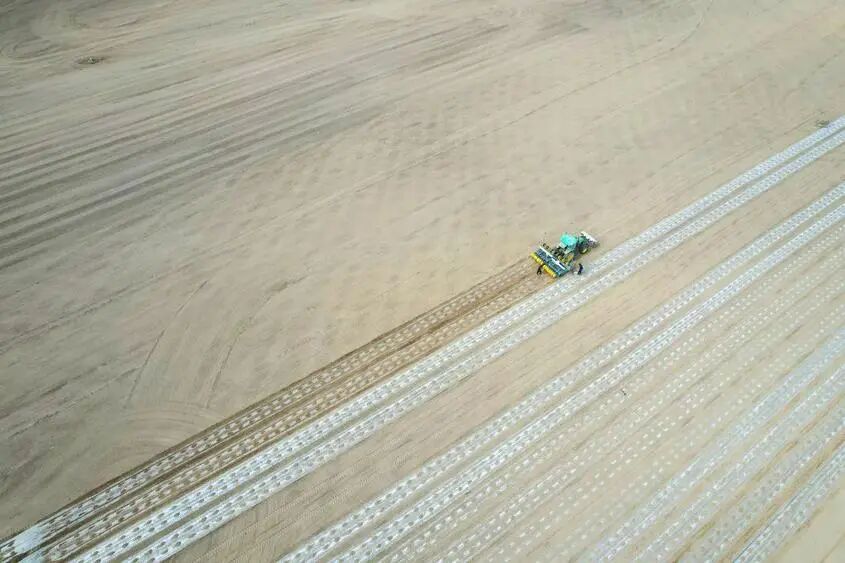
On March 24, reporters visiting Elesentaogai South Village in Daheyanyazi Town observed three unmanned tractors—equipped with the BeiDou Navigation Satellite System—shuttling back and forth across the fields of cotton grower Suleimannai, precisely following pre-programmed sowing routes. Workers followed closely behind, meticulously inspecting every step of the operation—including furrowing, seeding, plastic mulching, and soil covering—creating a vibrant scene of bustling activity across the fields.
"I am currently sowing cotton; this year, I’ve planted 2,100 mu. With three machines operating simultaneously, we can sow over 400 mu a day. At this pace, we should be finished in about a week," said Suleimannai.
In recent years, Jinghe County has vigorously promoted an advanced approach to cotton cultivation that integrates "superior fields, seeds, machinery, and techniques." Furthermore, the county has implemented a "Five Unifications" model for large-scale planting management, aiming to enhance cotton quality right from the source. This year, Elesentaogai South Village in Daheyanyazi Town is pioneering an "intercropping" model combining cotton and cumin. Suleimannai has applied this intercropping method to all 2,100 mu of his cotton fields, utilizing "Xinluzao No. 78"—a variety actively promoted by Jinghe County—as his chosen cotton seed. "Last year, we planted using a 'one-film, three-row' configuration; this year, as we are intercropping with cumin, we have switched to a 'one-film, four-row' layout. Previously, when I farmed in Southern Xinjiang using the 'one-film, four-row' method, cotton yields reached nearly 500 kilograms per mu, while cumin yields hovered around 60 kilograms per mu. This year, Jinghe County is actively promoting this practice, and—crucially—the local temperatures have risen about 10 days earlier than usual. This makes the climate here quite similar to that of Southern Xinjiang, rendering it highly suitable for intercropping with cumin. Upon learning of my plans to intercrop, the Jinghe County authorities assigned technical experts to provide continuous, end-to-end guidance—offering assistance in every aspect, from water management and soil quality to the operation of precision planters. Consequently, I am very confident in the success of this year's cumin intercropping," stated Sulaimannai.
Intercropping cotton with cumin represents an innovative agricultural model that not only maximizes land utilization but also fosters crop diversification. Cumin is a widely used spice belonging to the *Cuminum* genus within the Apiaceae family. It features a growth cycle of 60 to 70 days and is classified as a semi-hardy crop capable of thriving in climates with significant temperature fluctuations. Ready for harvest by mid-June, it has opened up a new avenue for income generation for local farmers.
To accelerate the pace of cotton sowing and promote scientifically guided spring farming, the Jinghe County Bureau of Agriculture and Rural Affairs has partnered with various townships and state farms. They have mobilized a team of over 20 professional technical experts to deploy directly to the front lines of the spring sowing campaign. These experts are providing comprehensive technical guidance, rigorously overseeing both the quality and speed of sowing operations, resolving technical challenges for growers, and facilitating the transition to precision, mechanized cotton planting. Concurrently, the Bureau has established a collaborative prevention and response mechanism with various county-level government departments to safeguard and ensure the smooth execution of spring sowing activities.
According to reports, the total area dedicated to cotton cultivation in Jinghe County this year spans 1.1 million mu. Sowing operations have already commenced in succession across the region, with the entire cotton sowing process projected to be completed by mid-April.